The sources outline a significant legal and regulatory struggle regarding the implementation of Front-of-Package Warning Labels (FOPL) on packaged foods in India.
Key Points from the Sources:
Legal Mandate:
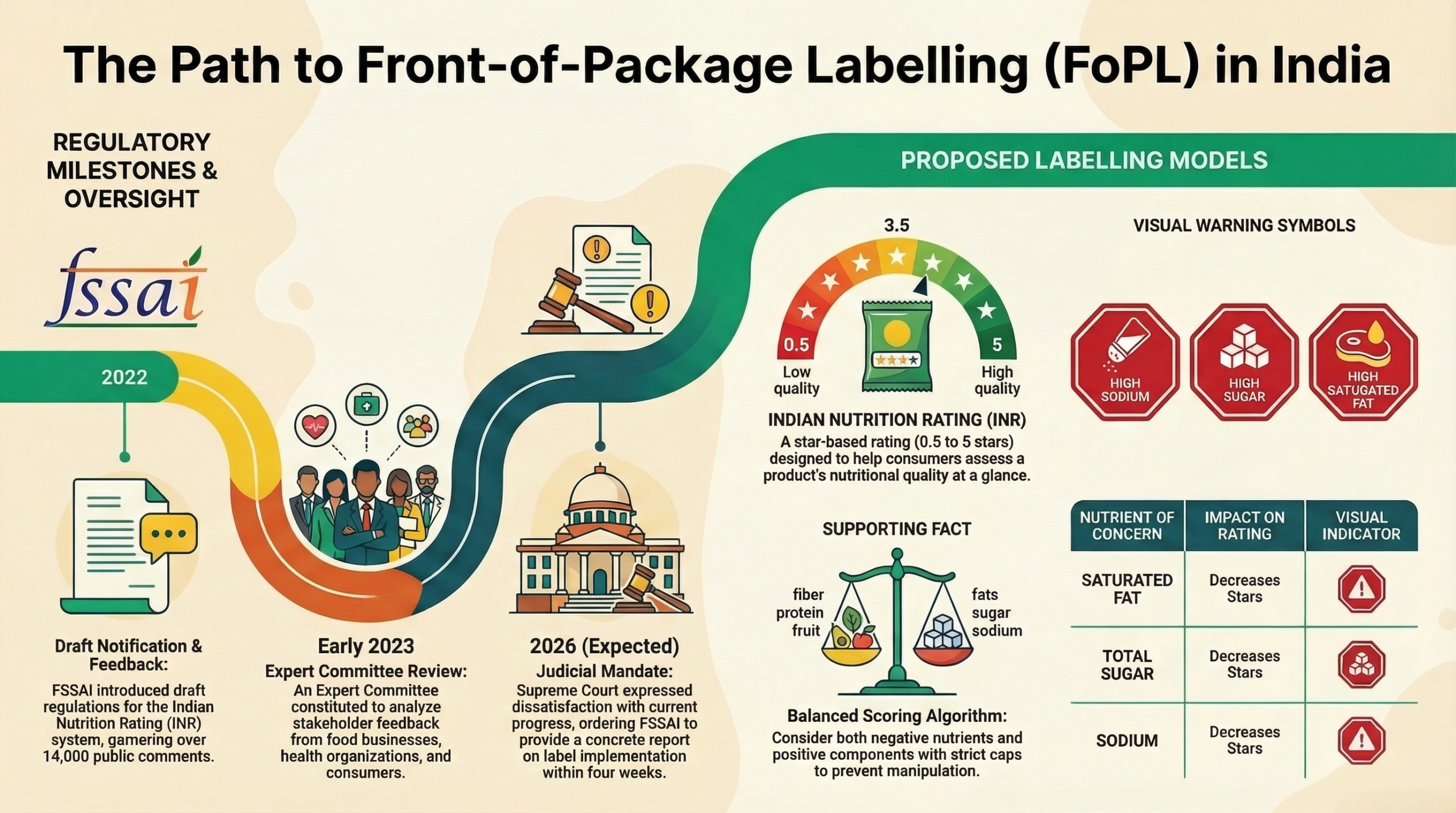
- A Public Interest Litigation (PIL) was filed by the “3S and Our Health Society” seeking a Writ of Mandamus to compel the Union of India and the Food Safety and Standards Authority of India (FSSAI) to regulate clear warning labels on packaged foods. This petition is rooted in the constitutional right to health for Indian citizens.
Proposed “Indian Nutrition Rating” (INR):
- The FSSAI initially proposed a star-rating system (ranging from 0.5 to 5 stars) called the INR. This model attempts to balance “negative” nutrients (sugar, salt, saturated fat) against “positive” components (fiber, protein, vitamins) to provide an overall health score.
Regulatory Stagnation:
- Despite receiving over 14,000 public comments and forming an Expert Committee in early 2023, the FSSAI reported in 2026 that there is no consensus among stakeholders regarding the INR format. The committee expressed concerns about the feasibility of the algorithm and suggested further research, surveys, and mapping before implementation.
Supreme Court’s Dissatisfaction:
- The Court expressed that the regulatory exercise so far has not yielded any positive results. It rejected the FSSAI’s latest compliance affidavit and is currently considering a petitioner’s suggestion for explicit, high-visibility warning symbols (such as red circles indicating “High Sugar” or “High Sodium”) rather than just a star rating.
International Precedent:
- The Court noted that FOPL is already internationally prevalent, suggesting that India is lagging in adopting these public health standards.
Analysis and Views:
The core conflict in these sources is between a “summary” star rating (the INR) and “nutrient-specific” warning labels (the petitioner’s suggestion).
Clarity vs. Complexity:
- From a public health perspective, the star-rating system (INR) can be controversial because it allows “positive” ingredients like fiber to “offset” the presence of high sugar or salt in a product’s score. This may potentially confuse consumers who might see a 3-star rating on a product that is still dangerously high in sodium. In contrast, the red warning symbols suggested by the petitioner provide an immediate, unambiguous “stop-sign” effect that does not require the consumer to calculate a balance of nutrients.
Industry vs. Public Health:
The FSSAI’s mention of “economic inclusivity” and the need for “wider stakeholder consultation” with industry players suggests a tension between protecting public health and minimizing the impact on food businesses. The Court’s frustration likely stems from the fact that while the FSSAI seeks more “systematic mapping,” the rise of diet-related diseases continues to impact the “right to health”.
“Bold Lettering” Alternative:
- The sources mention a 2025 proposal to simply put nutrition information in bold letters. Based on the Court’s reaction, this appears to be viewed as an insufficient compromise that does not meet the goal of a clear, front-of-package warning.
Information not from the sources:
- You may wish to independently verify that many countries, such as Chile and Mexico, have already successfully implemented high-nutrient warning labels (black octagons), which studies have shown to be more effective at reducing the purchase of unhealthy foods than star ratings or “traffic light” systems.
Download, Read & Share:
- Apprppriate directions OR making regulation for Front-of-Package Warning Labels on Packaged Foods
For more information, please Chat with us Ask The Expert.
Resources
Apprppriate directions OR making regulation for Front-of-Package Warning Labels on Packaged Foods
 Home
Home App Features
 About
About Contact Us
 Legal Compliance
 Food Safety
 News
News Certifications
 Start Up Food
 Business-Type-What am I into ?
 How to Become
 Resource






 Continue with Google
Textexplain.com
04:13 AM, Mar 27thThis is a great article.