The provided sources outline the regulatory framework and operational guidelines for E-commerce Food Business Operators (FBOs) in India, established by the Food Safety and Standards Authority of India (FSSAI).
Key points from the documents include:
Scope and Definitions:
- E-commerce FBOs include entities that carry out food business activities through a digital and electronic network.
- They are categorized into two primary models: the marketplace-based model, where the platform acts as a facilitator between buyers and sellers, and the inventory-based model, where the entity owns and sells food products directly to customers.
- The definition covers a wide range of activities, including listing services, storage, distribution, and last-mile delivery transportation.
Licensing and Registration:
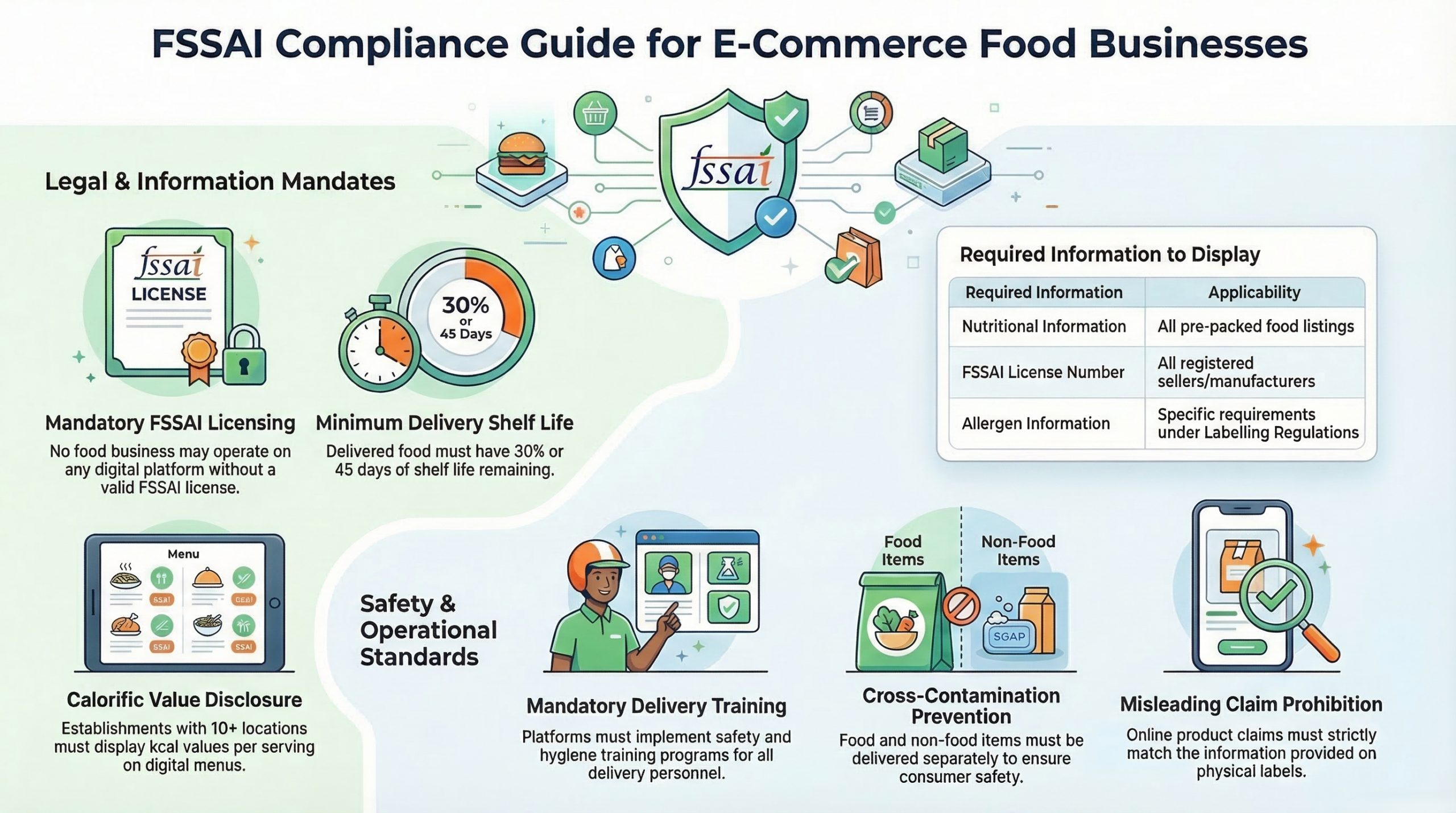
- All e-commerce FBOs must obtain a license from the Central Licensing Authority for their entire supply chain, including head offices and storage facilities.
- Entities providing only listing or directory services are not required to obtain a license, provided they do not fall under the definition of a “food business” under the Act; however, they must still ensure they do not display misleading information.
Information Display Requirements:
- Mandatory Labeling: For pre-packed food, a clear image of the “principal display panel” must be visible on the platform, excluding batch numbers, expiry dates, and MRP.
- Nutritional Disclosure: Food service establishments with a central license or more than 10 locations must display caloric values (kcal per serving) and nutritional/allergen information on digital platforms.
- Seller Transparency: The FSSAI license or registration of the seller/manufacturer must be displayed on the e-commerce platform.
- Claims: E-commerce platforms are cautioned against making unsupported or misleading claims online.
Food Safety and Quality Standards:
- Shelf Life: Delivered food must have a minimum remaining shelf life of 30% or 45 days at the time of delivery to the consumer.
- Hygiene Practices: FBOs must comply with basic hygiene and sanitary practices (Schedule 4), which include maintaining potable water supplies, proper waste disposal, and pest control.
- Contamination Prevention: Food and non-food items should be delivered separately to avoid potential contamination.
- Last-Mile Delivery: E-commerce FBOs must ensure that delivery personnel are trained in food safety and hygiene protocols.
Compliance and Consumer Redressal:
- Recall Responsibility: Platforms must immediately delist any products that do not comply with FSSAI regulations.
- Complaints: E-commerce FBOs must have a consumer complaint cell to handle issues regarding product efficacy and quality, coordinating with manufacturers for resolution.
- Sampling: Food products offered for sale on these platforms are liable for sampling at any point in the supply chain.
Download, Read & Share:
- Compliance obligations of E-commerce FBOs in the context of Open Network for Digital Commerce model
For more information, please Chat with us Ask The Expert.
Resources
Compliance obligations of E-commerce FBOs
 Home
Home App Features
 About
About Contact Us
 Legal Compliance
 Food Safety
 News
News Certifications
 Start Up Food
 Business-Type-What am I into ?
 How to Become
 Resource






 Continue with Google
No comments