Food safety is a systematic approach to ensuring that food is safe and nutritious throughout the entire supply chain, from the moment raw materials are received until the food is served to a consumer. For a beginner, the most important concepts can be broken down into personal hygiene, the cleanliness of the environment, and the “journey” of the food itself.
Personal Hygiene: The First Line of Defense
As a food handler, your health and habits directly impact food safety.
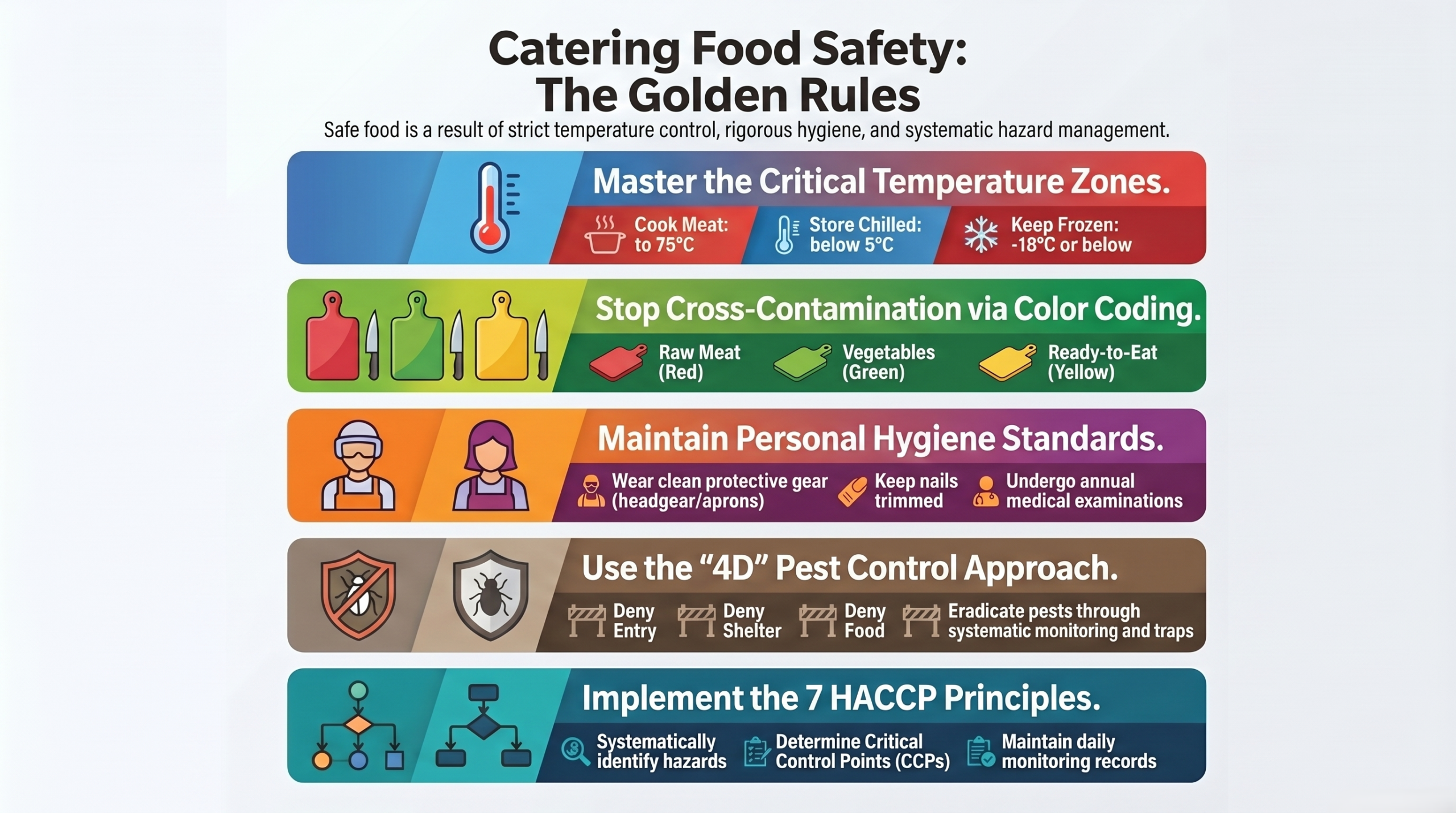
- Health Status: Food handlers must undergo annual medical examinations to ensure they are free from infectious diseases. If you have symptoms like diarrhea, vomiting, jaundice, or fever, you must report them and stop handling food immediately.
- Hand Washing: This is the single most important habit. You must wash your hands after using the toilet, smoking, handling cell phones, touching raw meat, or coughing.
- Protective Clothing: Always wear clean work clothes, hairnets, and footwear. Jewelry, watches, and strong perfumes should be avoided as they can contaminate food or fall into it.
- Behavior: Avoid habits like scratching your nose, running fingers through your hair, or spitting in food preparation areas.
Hygiene requirements apply to both the facility’s amenities and the personal conduct of food handlers.
- Personal Hygiene Facilities: At least one hand-washing station must be available in each preparation area, equipped with liquid soap and single-use paper towels. Toilets must not open directly into food handling areas and should have double doors if adjacent to them.
- Health and Cleanliness of Staff:
- Medical Exams: Food handlers must undergo annual medical examinations and be vaccinated against enteric diseases.
- Reporting Illness: Staff must report symptoms like jaundice, diarrhea, vomiting, or infected lesions and stop handling food immediately.
- Protective Clothing: Handlers must wear clean work clothes, head coverings, and appropriate footwear.
- Behavioral Controls: Practices like smoking, spitting, or chewing are strictly prohibited in food areas. Handlers should also avoid “hand habits” like scratching their nose or running fingers through their hair.
- Hand Washing Protocol: Hands must be washed frequently, including after using toilets, handling cell phones, smoking, coughing, or touching raw food.
A Clean Environment:
The space where food is prepared must be designed to prevent contamination.
- Location: The facility should be away from environmental pollution like garbage dumps or stagnant water, which attract pests.
- Pest Control (The 4Ds): To keep pests away, follow the “4Ds” approach: Deny Entry (seal holes), Deny Shelter (remove clutter), Deny Food (clean up scraps), and Eradication (use traps or professional services).
- Cleaning vs. Sanitizing: Cleaning removes visible dirt and grease using water and detergent, while sanitizing uses chemicals (like chlorine) or heat to kill invisible bacteria.
The Journey of Food (Control of Operations):
Every step in the food production process has specific safety rules.
Receiving & Storage
- Temperature Checks: When receiving chilled food, it must be at or below 5°C. Frozen food must be at or below -18°C.
- FIFO & FEFO: Use First In, First Out (FIFO) and First Expire, First Out (FEFO) to ensure older stock is used before it spoils.
- Safe Stacking: In a refrigerator, always store raw meat on the bottom shelf and cooked foods or salads on the top shelves to prevent raw juices from dripping onto ready-to-eat food.
Preparation & Thawing
- Color-Coded Cutting Boards: Use different boards to prevent cross-contamination. For example: Red for raw meat, Green for vegetables, and Yellow for cooked food.
- Safe Thawing: Never thaw food at room temperature. Use a refrigerator (at 5°C or less) or cold running water for a maximum of 90 minutes.
Cooking & Reheating
- Core Temperatures: Food must be cooked to a safe internal temperature to kill pathogens.
- Vegetarian food: 65°C for 2 minutes.
- Non-vegetarian food: 75°C for 15 seconds.
- Reheating: Food should be reheated only once to a core temperature of 75°C for 2 minutes.
Service
- The Danger Zone: High-risk foods should be kept hot (above 65°C) or cold (below 5°C). If hot food drops below 65°C, it must be consumed within 2 hours or discarded.
Identifying Risks (HACCP):
HACCP (Hazard Analysis and Critical Control Points) is a systematic, management-driven approach that helps identify, assess, and control microbiological, chemical, physical, and allergenic hazards throughout the catering supply chain. Unlike traditional inspection methods, it focuses on preventing safety problems at specific points in the production line where they are most likely to occur.
The framework uses seven core principles to identify and manage risks:
Identifying Risks through Hazard Analysis
The first step is conducting a hazard analysis to list all potential biological, chemical, or physical hazards that could reasonably occur at every stage of the catering process, from procurement to service. This includes evaluating the likely occurrence and severity of health effects, such as the survival of microorganisms or the presence of toxins.
Determining Critical Control Points (CCPs)
HACCP identifies Critical Control Points (CCPs), which are specific steps where control can be applied to prevent, eliminate, or reduce a hazard to an acceptable level. For example, in a catering setting, cooking is a CCP because it is the specific stage designed to eliminate pathogens. A “Decision Tree” is often used as a logic tool to help teams determine if a step truly is a CCP.
Setting and Monitoring Safety Boundaries
Once CCPs are identified, the system establishes Critical Limits, which are measurable boundaries (such as specific temperatures or times) that must be met to ensure safety.
- Monitoring Systems: Caterers must establish procedures to observe or measure these limits. For instance, a chef assistant might use a thermometer to check that non-vegetarian food reaches a core temperature of 75°C for 15 seconds.
Establishing Corrective Actions
When monitoring shows that a critical limit has been exceeded (a “deviation”), pre-planned corrective actions must be taken. These actions ensure the process is brought back under control and determine the proper disposition of the affected product, such as discarding food that was held in the “Danger Zone” for too long.
Verification and Record-Keeping
- Verification: This involves activities like internal audits and self-evaluations to confirm that the HACCP system is working effectively. The system must be reviewed at least annually or whenever the process changes.
- Documentation: Comprehensive record-keeping is required for every part of the plan, including the hazard analysis, CCP monitoring results, and any corrective actions taken. These records are essential for audits and for proving that the food served was safe.
Practical Example of HACCP in Catering:
In the Receiving stage of the catering cycle, a hazard might be the growth of food poisoning bacteria due to improper transport.
- The Control: Ensure chilled foods arrive at 4°C or below.
- The Monitoring: The receiver checks the temperature with a thermometer upon arrival.
- The Corrective Action: If the temperature is too high, the raw materials are rejected and returned to the supplier.
Based on the provided guidance document, essential requirements for hygiene and facility design in the catering sector focus on preventing contamination through strategic location, purposeful layout, and strict personal hygiene standards.
Facility Design and Layout:
A well-designed food establishment minimizes contamination risks by controlling the movement of employees and food.
- Location and Surroundings: Facilities should ideally be located at least 30 meters away from environmental pollutants like smoke, dust, stagnant water, and garbage dumps, which attract pests. If located in a high-risk area, the premises must be enclosed and protected with measures like air curtains and rodent traps.
- One-Way Food Flow: The layout should facilitate a unidirectional flow of food—from receiving and storage to preparation, cooking, and finally packaging or service—to prevent cross-contamination between raw and finished products.
- Internal Structures:
- Floors: Must be non-absorbent, impervious, and easy to clean.
- Walls: Should be smooth, non-absorbent, and washable up to an appropriate height.
- Ceilings: Must be constructed to prevent dirt accumulation and condensation.
- Windows and Doors: Windows opening to the outside must have insect-proof screens, and doors should be smooth, non-absorbent, and close-fitting to exclude pests.
- Equipment Quality: All equipment and containers in contact with food must be made of durable, non-corrosive, and non-toxic materials that are free from cracks and crevices.
Essential Utilities and Facilities:
- Water Supply: Only potable water (meeting IS:10500 standards) should be used for food preparation, ice, steam, and cleaning surfaces that contact food.
- Waste Management: Waste should be segregated into color-coded bins (Wet, Dry, and Other). Wet garbage bins in production areas should ideally be foot-operated and must be removed at least once per session.
- Lighting and Ventilation: Sufficient lighting is required, specifically 500 lux at surfaces where high-risk foods are handled. Ventilation systems must prevent grease or condensation from dripping onto food and ensure air does not flow from contaminated areas to clean ones.
- Storage: Food must be stored at least 15 cm (6 inches) off the floor and away from the walls to allow for effective cleaning and inspection.
Download, Read & Share:
- FSMS Guidance Document for Catering Sector
For more information, please Chat with us Ask The Expert.
 Home
Home App Features
 About
About Contact Us
 Legal Compliance
 Food Safety
 News
News Certifications
 Start Up Food
 Business-Type-What am I into ?
 How to Become
 Resource






 Continue with Google
textslangs
01:30 AM, Apr 30thThis guide explained everything clearly.